
COMPLETE INVENTORY OF DISPLAY CASE/SHOWCASE EQUIPMENT
FIRST ROOM
Section No. 1
- 4 Laryngeal Masks, designed in 1981 by Dr. Archie Brain
- 1 Prototype of the masks, donated by the inventor (held by only 2 museums in the world: R.C.A. in London and the Villafranca Museum)
- 3 Videocassettes demonstrating the operation of the masks
Section No. 2
- 1 Extractor for bladder stones in metal spiral and horsehair (mid-19th century – extremely rare instrument, only 2 known specimens in the world)
Above: High-relief pillar dedicated “To the Doctors Fallen in War”
Section No. 3
- 1 Crystal female urinal (pappagallo) – early 20th century
- 1 Majolica vaginal douche tool (late 19th century)
Section No. 4
- 3 Glass feeding bottles (used in France, late 19th century) – the 1st has the child’s name engraved and an ivory cap
Section No. 5
- 19 Disposable military vials for field blood sampling (with anticoagulant liquid still inside, needle embedded in the glass)
- Plaque of Cav. Dr. Ottavio Badessa, Physician and Surgeon
- 1 Needle container (early 20th century)
Section No. 6
- 6 Various syringes in bakelite and glass, metal and glass, or all glass, with regulating screw
- 2 Syringe holders
Section No. 7
- 1 Ring syringe with a long, thin needle for extensive local anesthesia (equipped with a two-way valve and suction spring)
- 1 Ring syringe with a long, thin needle for extensive local anesthesia (equipped with a two-way valve)
- 1 Metal box with ring syringe, needles of various gauges, and a two-way valve for cavity emptying
- 1 Ring syringe with a long curved nozzle for cavity irrigation
- 1 Insulin syringe with colored glass piston, in a metal box (1920s/30s)
- 2 Syringe holders
- 1 Videocassette
Section No. 8
- 1 Small pocket container with a bottle of “Salts” (ammonia) – 1920s/30s
- 8 Various glass injectors, some with bakelite parts
- 1 Cylindrical compressed cardboard container with a sealed vial containing a capillary
Section No. 9
Below:
- 1 Portable military anesthesia machine, complete and never used (tubes for nitrous oxide, oxygen, and air)
- 9 Various “Gord” needles, complete with container with spare rubber discs and tongue depressors (one with oxygen attachment)
- 3 Mouth gags for tonsillectomy
- 1 Heister mouth gag (also used as an intercostal retractor in thoracic surgery)
- 9 Various “tongue-pulling” forceps
- 1 Cyclopropane canister (highly explosive anesthetic gas)
- 2 Ethyl chloride spray vials (local anesthesia or induction)
- 2 Tongue depressors
- 1 Tube clamp
- 3 Nozzles
- 6 Tracheotomy cannulas
In the center:
- 1 Pulse watch
- 2 Military oxygen masks (USA)
- 1 Jackson pediatric laryngoscope in brass with built-in 6V lamp
- 1 Nasal anesthesia mask (dental procedures)
- 1 Braun anesthesia apparatus for Ether or Chloroform (1920s/1930s, military use)
- 1 Nasal anesthesia mask (second specimen)
- 1 Box with 16 nozzles + 2 external + 2 rubber cannulas
Above:
- 2 Bottles of sterile injectable solutions for hypodermoclysis
- 1 Anesthesia mask
- 2 Pressure gauges
Section No. 10-11
Below:
- 2 Aspirators with pressure gauge and push-button switch
- 2 Pressure gauges for O2 and N2O cylinders
- 1 Oxygen therapy regulator with pressure gauge
- 1 Colorimetric device for measuring CO2 in the anesthetic circuit
- 2 Pediatric “soda lime” containers
- 2 Ethyl chloride spray vials
- 1 Complete anesthesia apparatus with Trilene for minor procedures and analgesia in childbirth (with 5 vials) – formerly belonging to Dr. Ottavio Badessa
- 9 Analgizer tubes
- 1 Disposable mouthpiece for mouth-to-mouth resuscitation
In the center:
- 1 Large size bag for American respirator (circa 1930-40)
- 1 Rubber part to be applied to metal masks
- 1 Black bakelite mask with ether/chloroform reservoir and oxygen attachment
- 1 Red rubber mask with valve
- 2 Chrome-plated metal masks for short anesthesia with Ether or Ethyl Chloride
- 1 Schimmelbusch mask (1920s/30s – ether or chloroform anesthesia)
- 1 Juillard mask
- 2 Esmarch masks
- 1 Ether bottle
Above:
- 3 Bottles for ether or chloroform
- 1 Penthrane vaporizer
- 1 Metal dropper
- 2 Aspirator containers
- 1 Metal aspirator
Section No. 12
Below:
- 1 Ombredanne apparatus (French version ca. 1908-1910) for ether/chloroform, complete with dried pig’s bladder bag
- 1 Rendle ether mask (likely similar to the one used by Hewitt for King Edward VII in 1902)
- 1 Ombredanne apparatus (English version 1910/12) for ether/chloroform, complete with dried pig’s bladder bag
In the center:
- 1 Ombredanne apparatus (Italian version ca. 1909-10) for ether/chloroform, complete with box and dried pig’s bladder bag
- 2 Ombredanne apparatuses (Italian version – third and fourth specimens of the collection)
Above:
- 1 Complete set of rotameters and vaporizer
- 1 Trilene inhaler for analgesia in childbirth
- 1 Ether vaporizer from a Boyle anesthesia machine
Section No. 13
Below:
- 1 Complete set of 14 surgical instruments with oval container (American military: catgut, silk, needles, and sterilization box)
- 1 Roll of steel suture wire
- 1 Forceps for small eyelets of various sizes
- 2 Boxes with Paquelin Thermocautery + 12 metal pieces
- 2 Metal tools + 1 pouch with 5 files
In the center:
- 2 Vials with sterile catgut
- 1 Metal box for sterile compresses
- 12 Various surgical instruments
- 13 Extractors for bullets and foreign bodies
- 2 Suprapubic cannulas with ebony handles (mid-19th century)
- 1 Long knife with ebony handle for anatomical sectioning (mid-19th century)
- 2 Sterile threads
- 1 Diathermy handles
- 2 Tensioners for wire saw + metal wire
Above:
- 1 Scale (found in the operating complex of an old hospital)
- 1 American metal surgical instrument box (World War II)
- 1 Transformer for medical electrical devices (low voltage light)
Section No. 14
Below:
- 1 Military surgical box with 18 instruments (saw, hammer, ebony handle – late 18th century, Napoleonic battles?)
- 1 Complete set of 4 scalpels in their own metal box
- 1 Wooden box with 9 urethral dilators (formerly belonging to Dr. Ottavio Badessa)
- 5 Various urethral probes
- 1 “Gillette” device for sharpening razor blades in the operating room (1930s)
- 1 Electronic nerve detector for use during surgery (modern)
- 1 Durex box with rubber finger cots
In the center:
- 1 Circular support for vials to be sterilized
- 1 Bandage winder
- 1 Extensible forceps for picking up soiled gauze from the floor
- 1 Hemostasis instrument with brass screw systems (years 1718-1900)
- 1 Bilateral hernia containment belt in leather and hide (1940s/50s)
- 1 Needle container
- 1 Vaseline dispenser
- 7 Various probes and thin sounds
- 1 Sterilizable automatic deodorant and disinfectant emitter
Above:
- 1 Small autoclave basket
- 1 Electric boiler for sterilizing instruments and syringes (formerly belonging to Dr. Ottavio Badessa)
- 1 Bandage winder (second specimen)
- 1 New tool (cautery)
Section No. 15 – Corridor showcase (84 main tools)
- 2 Reflex hammers (formerly belonging to Dr. Ottavio Badessa)
- Various biopsy forceps
- 1 Whetstone for sharpening scalpels (used by Dr. Ottavio Badessa)
- 1 Tracheotomy retractor
- 1 Skull drilling instrument with depth regulator
- 2 Smallpox vaccination instruments
- 1 Famous painting by Rembrandt
- Forceps for applying and removing “clips” (dual use)
SECOND ROOM
Section No. 16
Below:
- 2 “High frequency” attachments and relative handle (see also Section No. 28)
- 1 Electroshock machine (gift of Prof. Nino Ioli)
In the center:
- 1 Boiler with 22 tools + group of 13 tools (gift of Doctors Arcangelo and Antonello Franco in memory of their father Dr. Rosario Franco, local physician)
Above:
- 5 Bottles and 3 books by Prof. Claude Jasmin
Section No. 17
Below:
- 2 Leaded gloves for radiology (hand protection for radiologist/orthopedist)
- 1 Fluorescent screen for fluoroscopy (used to see before taking the X-ray or for manipulation/fracture reduction)
- 1 Dental negatoscope (very rare instrument)
- 2 X-ray generating cathode tubes (taken from the Gorla-Siama apparatus used by Dr. Ottavio Badessa)
- 3 Lead containers for transporting radioisotopes
- 1 Apparatus for the production of radioisotopes (1950s/1960s)
- 3 “Plate-holding” tweezers
- 6 Darkroom lamps
In the center:
- 1 Microscope with 3 rotating objectives (early 20th century)
- 1 Nachet brass microscope with 2 rotating objectives, in a Nachet-marked box (late 19th century)
- 1 Drum microscope complete with box (first half of the 19th century)
- 1 Brass microscope with 2 rotating objectives – London, late 19th century
- 1 Maya figurine depicting a patient with angina pectoris
- 1 Maya figurine depicting an ascitic patient
- 1 Maya figurine depicting a Peruvian doctor
- 1 Wooden box
- 9 Glass slides + 4 glass vials
Above:
- 12 Bottles
Section No. 18
Below:
- 1 French ionizer complete with accessories and literature (4 volumes) – early 20th-century medicine for conveying drug ions to the body
In the center:
- 25 Dropper bottles (one with a label from the Cardiel Pharmacy in Caltagirone)
Above:
- 4 Bowls
Section No. 19
Below:
- 1 Box with 5 ophthalmic surgery tools with ivory and bone handles (mid-19th century, pre-sterilization)
- 1 Box with 4 tools + 1 small scissors for ophthalmic surgery
- 1 Box with 5 ophthalmic surgery tools (sterilizable, more recent)
- 6 Ophthalmic surgery tools
- 1 Small box with pen magnet (for metallic foreign bodies in the eye)
- 1 Slit lamp (donated by Dr. Umberto Mondello)
- 1 Javal ophthalmometer (donated by Dr. Umberto Mondello)
In the center:
- 1 Wilbur Marple ophthalmoscope (ivory handle, without electric current – year 1906)
- 1 Marple ophthalmoscope, complete with transformer attachment
- 1 Transformer for medical electrical devices
- 1 Box with 5 ophthalmic surgery tools
- 1 Small wooden box with ophthalmic scalpel (for cataracts)
- 3 Eye measurement tools
- 2 Bottles of eye drops
- 1 Book “Diseases of the Eye”
- 1 Book “The Fundus of the Eye”
- 1 Box with lens apparatus
- 1 Small bottle of refreshing drops
- 1 Tweezers
- 4 Lens containers
- 1 Small box with 16 enzyme sachets
Above:
- 31 Books
Section No. 20
Below:
- 4 Complete craniotomy sets with ebony handles (mid-19th century – for extracting the fetus in case of intrauterine death)
- 2 Gold-plated cannulas used as contraceptives (precursors to the “coil” – fixed to the cervix, very dangerous)
- 1 Metal box with instruments for uterine curettage (formerly belonging to Dr. Ottavio and Paolo Badessa): 19 retractors, 2 vaginal retractors, 14 curettes, 11 dilating instruments
In the center:
- 1 Electric nebulizer in its own box (late 19th/early 20th century)
- 4 Aerosol therapy units in four different models
- 1 Lady’s handbag aerosol
- 1 Complete “Silbe” atomizer
- 2 Boxes of backlit instruments for cavity exploration (1950s-60s)
- 3 “Medicine for Man” cases
- 1 Videocassette “Antibiotica colloquia”
- 21 Booklets
Above:
- 39 Volumes of general medicine (Testut – anatomy and others)
Section No. 21
Below:
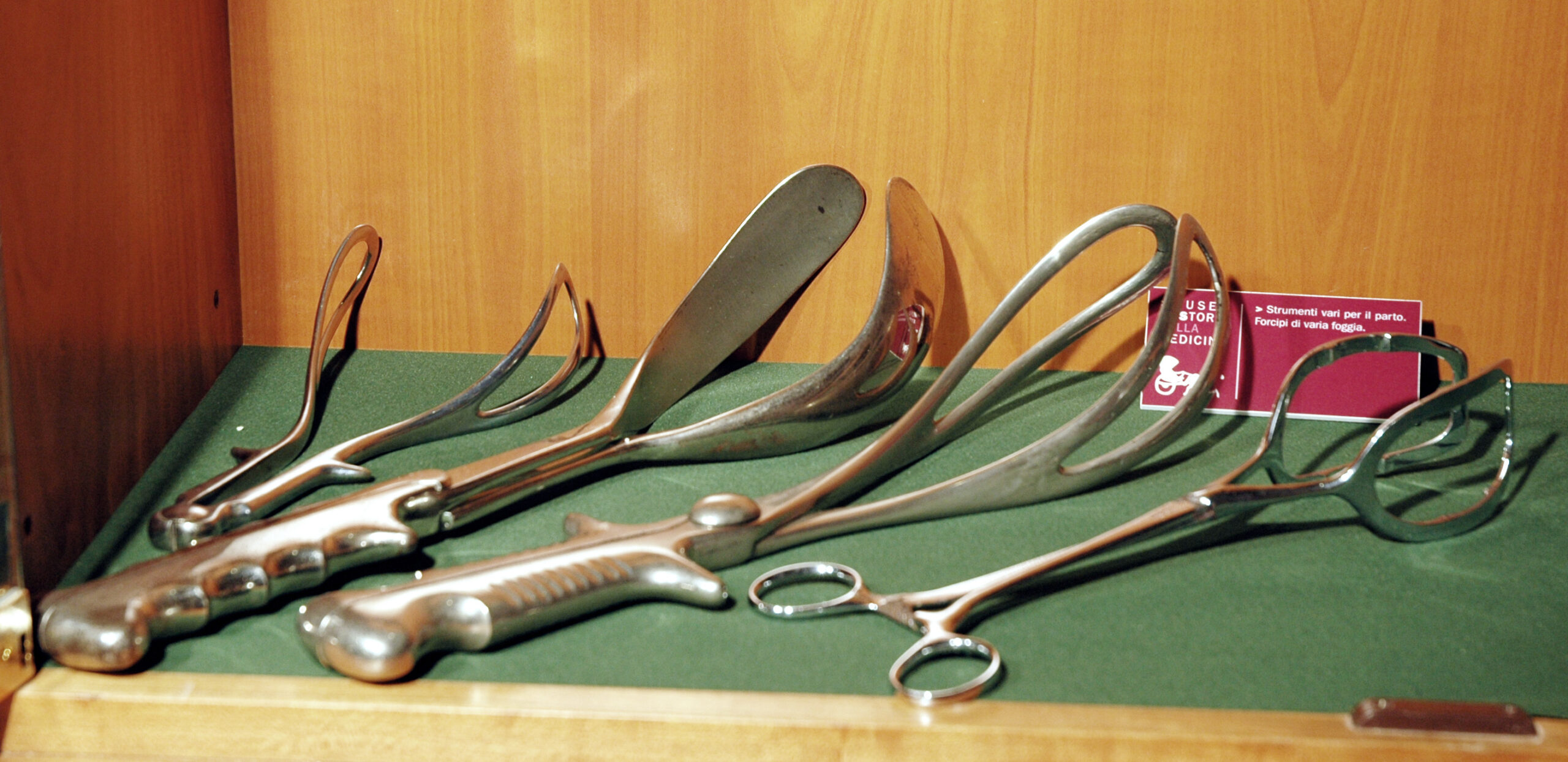
- 4 Various childbirth instruments (forceps of various shapes and sizes)
- 1 Vacuum extractor for fetal extraction (in use since the late 1950s)
- 1 Instrument for looking inside the vagina (small size, for virgins)
- 2 “Corkscrew” tools for holding the uterus during hysterectomy
- 1 Uterine clamp for hysterectomy surgery
- 1 Pelvimeter (to assess pelvic width relative to the fetus)
- 1 Instrument for pulling the fetus
In the center:
- 1 Obstetric stethoscope in wood and rubber tube lined with silk braid (ca. 1910)
- 13 Pessaries of various sizes for vaginal prolapse
- 4 Pessaries in original box
- 1 Glass breast pump with ivory nozzle
- 1 Sleep bio-inducer for infants (1950s, simulates the maternal heartbeat)
- 2 Videocassettes (gastroenterology and systemic mycoses)
Above:
- 25 Volumes on internal medicine
Section No. 22
Below:
- 1 Ceramic foot warmer
- 1 Electromedical device by Dr. A. Mundo
In the center:
- 29 Various small bottles (some with Gugliotta Pharmacy label from Patti)
- 1 Metal container
Above:
- 10 Bottles
- 3 Containers
Section No. 23
Below:
- 1 Complete orthopedic box with 19 instruments for surgery
- 2 Antique drills for orthopedic surgery (one with attachment for Kirschner wire – operating at 120V, 1930s-40s)
- 1 Thickness gauge
- 1 Spatula
- 1 Surgical instrument for fixing “greenstick” fractures
- 6 Various bridges for phalangeal traction
- 1 Electric vibro-massager complete with accessories (1930s-40s)
- 1 Manual hand-cranked vibro-massager (Scandinavian, 1920s-30s)
- 1 Working “drop” drill (150V)
- 1 Bone-cutting wire
- 6 Various tools
In the center:
- 3 Sluder “guillotines” for tonsillectomy
- 1 Box complete with mirror otoscope, magnifying lenses, and small mirror
- 1 Folding metal tongue depressor
- 2 “Tuning forks” (formerly belonging to Dr. Ottavio and Paolo Badessa)
- 2 Extensible mirrors for otologists
- 1 Brunton otoscope in silvered nickel silver with optical prism and lenses (late 19th century, very rare instrument)
- 1 Adjustable nasal retractors
- 1 Corkscrew-style otological instrument for earwax plugs
- 2 Large frontal syringes for irrigation (one in glass and metal, one in bauxite – early 1900s)
- 2 Head mirrors for ENT
- 1 Hearing aid for the deaf with battery and headband (early 1900s)
Above:
- 12 Volumes “Medica Italiana”
- 2 Volumes “Human Anatomy”
- 36 Various volumes
Section No. 24
Below:
- 1 Box with 2 glass containers, red rubber tube, dropper, and needle for blood transfusions (bears the name of Prof. Dogliotti)
- 1 Special plastic infuser for liquids and special substances (modern)
- 1 Luminous sign for the car of the “Doctor on Home Visit” (formerly belonging to Dr. Paolo Badessa, 1950s)
- 1 Box with oscillometer for measuring arterial tone in the limbs
- 1 Box with oscillometer for measuring circulation in the lower limbs
- 1 Complete box of “Arial Disk”
- 1 Box with Ismelin vials (for sympathetic-type limb pain)
- 11 Modern “Port-a-Cath” for chemotherapy (various sizes and materials)
In the center:
- 2 Glass drippers with ground-glass stopcock (for laboratories)
- 1 Glass and water “Venturi” aspirator (for analysis laboratories)
- 1 Glass goblet with 3 hydrometers for various liquids
- 1 Spirit burner (laboratory spirit lamp)
- 1 Small tube of “Cafiaspirina”
- 1 Small laboratory bottle
- 4 Tweezers for clamping rubber tubes
- 1 Container with thermometer
- 2 Empty containers
- 1 Thermometer
- 1 Box of “State Quinine” tablets
- 1 Box with 6 glass cupping jars with suction pump (early 1900s)
- 1 Box with 12 glass cupping jars complete with large metal syringe
- 1 White rubber instrument
Above:
- 12 Various tools
- 1 Syringe with 3 boxes of needles
- 4 Needle containers (donated by Dr. Mundo)
- 65 Various books and Ciba magazines
Section No. 25
Below:
- 1 Apparatus for “Therapeutic Pneumothorax” complete with box (1930s/40s – for pulmonary tuberculosis)
- 1 Nasal oxygen diffuser (modern)
- 1 New and modern reflex hammer
- 2 Boxes with equipment for thoracentesis (1940s/1950s)
- 2 Boxes for “thoracentesis” (perfect, with syringe, tubes, needles, directional valves)
- 1 Scarificator for smallpox vaccination
- 3 “Trocar” tips with cannulas of various sizes (for draining ascites)
- 1 Triangular-shaped object in brass-plated metal
- 1 Metal container
In the center:
- 2 Attachments for enema in black bakelite
- 1 Large pewter syringe for “self-enema” (late 19th century, bought in London)
- 1 Complete box for pediatric enema in pewter (horn nozzle, silk tube – second half of the 19th century)
- 1 Apparatus for baptizing the child before birth (with holy water, inserted into the uterus)
- 1 Large pewter syringe for rectal therapy
- 1 Complete phonendoscope in a chrome-plated metal box (1940s/50s)
- 1 Complete box for sympathicotherapy with 5 pieces and instructions in French
- 1 Tube of “Preludin” tablets (contained amphetamine, used as an anorectic)
- 1 Phonendoscope with strap without tubes
- 1 Circular Swedish cardboard box for “Pharmacy” tablets
- 1 Wooden stethoscope (formerly belonging to Dr. Ottavio Badessa, used for many years)
- 2 Tabletop mercury sphygmomanometers (1940s/50s)
- 1 Small container for menthol
- 1 Dispenser box for wooden tongue depressors
- 3 Attachments for enema in black bakelite
Above:
- 39 Various volumes
Section No. 26
Below:
- 1 Wooden box with 3 drawers: 1st drawer (23 pieces), 2nd drawer (10 pieces), 3rd drawer (9 pieces) – complete equipment for an itinerant dentist
- 1 Metal box
- 1 Box with 1 syringe and 3 needles
In the center:
- 1 Ultrasonic device for dental tartar removal (one of the first for this type of therapy)
- 3 Metal tools for tartar
- 3 Bottles
- 2 Tools with rubber tube
Above:
- 4 Swedish Pharmacy bottles (about a century ago, from the auction of a deceased Swedish pharmacist’s house)
Section No. 27
Below:
- 1 Large-size rotating magnet electro-medical device (early 1900s, Faradic current, in a wooden box with key)
- 1 Rotating magnet electro-medical device, smaller box with brass braid conductors (late 19th century, “Electrotherapy for nervous diseases”)
- 1 Battery-powered electro-medical device for electrotherapy (early 1900s)
- 1 Potassium Bichromate and Sulfuric Acid electromedical device, complete with accessories and instructions (last half of the 19th century)
- 1 English battery-powered electro-medical device for electrotherapy (early 1900s)
- 2 Small glass bottles + 1 instruction sheet
In the center:
- 3 Objective holders + 2 boxes with slides
- 1 Brass microscope with a single objective, very antique (London, late 19th century)
- 1 Brass “field” microscope with 2 objectives and circular slides (early 1900s)
- 1 Mounted microscope lenses for vascular/ophthalmic microsurgery, in their own box (1920s/30s)
Above:
- 5 Swedish pharmacy bottles
Section No. 28
Below:
- 1 Complete apparatus for “High frequency” therapy with 10 pieces (neuromuscular stimulator, early 1900s, working)
- 20 “High frequency” attachments with relative handle
In the center:
- 1 Box with 50 tablets + 20 Laudanum tablets
- 1 Bottle of iodine tincture for external use
- 1 Box with 50 tablets of Basic Bismuth Nitrate and opium (empty)
- 1 Box of Adrenaline Hydrochloride T.V. with 6 vials
- 1 Bottle of Acetylsalicylic Acid
- 3 Various small bottles in clear glass
- 5 Various small bottles with red caps (gift of Dr. Franco Arcangelo)
- 4 Various small bottles
- 1 Small box of Narcopon Coronidi with 2 vials
- 3 Small metal boxes for needles of various sizes
- 1 White rectangular container with 1 saw + 14 scissors
- 23 Various tools
- 1 Box of metal needles
- 2 Boxes with 2 metal syringes
- 1 ENT device with 3 metal ear cones
- 1 Metal box
- 1 Metal knife for filing
- 1 Various tool
- 2 Small metal tools
Above:
- 61 Various books
- 5 Bottles and 3 books by Prof. Claude Jasmin (great oncologist from Paris)
EXHIBITS OUTSIDE THE SHOWCASES
- 1 Zeiss refractometer no. 1656 (ca. 1930) – donated by Mr. Umberto Mondello
- 2 Straitjackets used in Italian asylums – donated by Prof. Nino Ioli
- 1 Mannequin – donated by Mr. and Mrs. Nino and Nunzia Rizzo
- 1 Blood coagulation device – gift of Dr. Antonino Mundo
DONATION BY DR. ANTONINO MUNDO (09/25/2005)
- 11 Various medical tools/instruments
- 35 Volumes “Opera Medica” by A. Wassermann and Co. (Nos. 95–132, excluding 101, 122, 129)
- 6 Volumes “Minerva Dermatologica” (years 1966-1975)
- 2 Volumes Allergy – Allergic and Allergological Diseases (Ed. Vallardi)
- 2 Volumes Differential Medical Diagnostics (Fieschi-Wassermann)
- 38 Volumes Ciba magazine (Nos. 10–50, excluding 43, 45, 46)
- 1 Volume “Terapia” (M. Messini – V. Meccli, Ed. Universo Rome)
- 1 Volume “Medicina d’Urgenza” (Ed. Universo Rome)
- 1 Volume “Current Diagnosis” (Howard F. Conn, Ed. Universo)
- 1 “Manuale di Pediatria” (R. Jemma, Soc. Editrice Libraria Milan)
- 2 Volumes “Compendio di Anatomia Descrittiva Umana” (Ed. Vallardi)
- 1 Volume “Ormonoterapia in Ginecologia” (Joachim Ufer, Morgaghi Ed.)
- 1 Volume “Traitement des Maladies Véthéeuses des Membres Inférieurs” (Doin, J.D. Martinet)
- 1 Volume “Atlas der Hautkrankheiten und der Syphilide” – Dr. S. Ehrmann, 1912 (very antique)


